
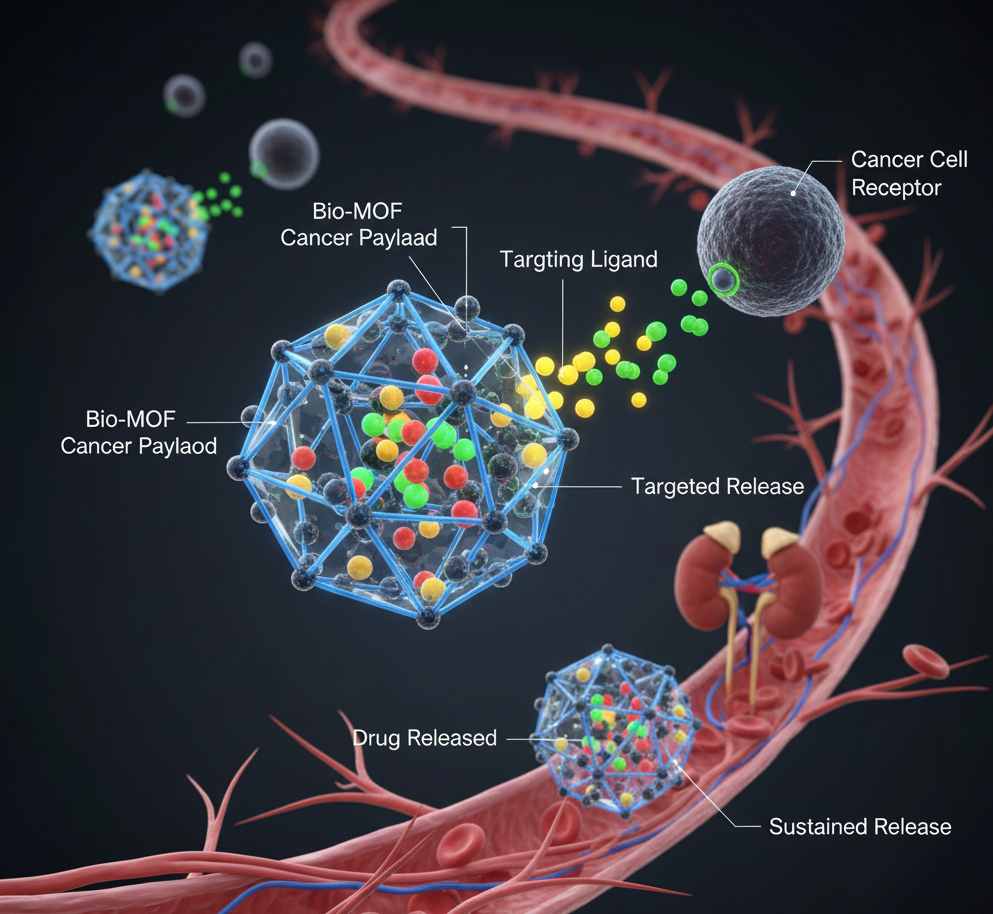
 Imagine a solid material where almost empty spaces and it is so porous , also a single gram of it has a surface area of larger than a football field. This revolutionary class of materials, called Metal-Organic Frameworks (MOFs), harnesses this “space” to tackle some of the world’s most urgent challenges, from reversing climate change to providing clean drinking water in arid regions, and critically, transforming advanced drug delivery and biomedicine.
In 2025, the Royal Swedish Academy of Sciences awarded the Nobel Prize in Chemistry to three visionary scientists: Susumu Kitagawa (Japan), Richard Robson (Australia), and Omar M. Yaghi (USA), for the development of these fascinating frameworks. Their work introduced a new design philosophy—Reticular Chemistry—where atomic-level construction allows chemists to stitch together predictable, functional, and highly porous materials.
“MOFs represent chemistry’s ability to create structures as intricate and useful as those found in nature.”
— The Royal Swedish Academy of Sciences, Nobel Press Release 2025
This article explores the historical journey, intricate architecture, groundbreaking contributions of Nobel Laureates, and essential applications of these super-porous materials, with a refined focus on their burgeoning role in nanomedicine and targeted drug delivery.
Historical Foundations: Building Blocks of Porous Materials
Before the advent of MOFs, chemists studied coordination compounds, simple complexes of metal ions and organic ligands. The revolution began when scientists realized these units could be linked into vast, three-dimensional networks.
In the 1970s and 80s, Richard Robson pioneered the concept of designing crystal frameworks based on topology—the geometric arrangement of the building blocks. His work provided the crucial architectural blueprint. By the early 1990s, Susumu Kitagawa formally demonstrated that these solids, which he termed “porous coordination polymers,” could act like dynamic sponges, capable of absorbing gases and even changing shape during the process.
The field truly crystallized with Omar M. Yaghi’s introduction of reticular chemistry—the deliberate, atomic-level construction of extended crystalline materials. Yaghi’s group created the first stable, high-surface-area MOFs, including the celebrated MOF-5 and HKUST-1, establishing the foundation for modern MOF research and design.
What Are MOFs? An Architectural Masterpiece
A Metal-Organic Framework (MOF) is a crystalline, porous solid constructed from two key components:
- Metal Nodes: These are typically metal ions (e.g., Zn2+, Cu2+, Fe3+, Zr4+) that function as the rigid “joints” or connectors.
- Organic Linkers: These are rigid, often polyfunctional organic molecules (like carboxylates or imidazolates) that act as “struts” or spacers, connecting the metal nodes.
The precise, repeated connection of these two components forms an ordered, robust network with uniform cavities and channels. This architectural tunability is what makes MOFs powerful; scientists can select specific metals and linkers to tailor the material’s pore size, chemical function, and surface area.
MOFs boast extraordinary surface areas, often exceeding 5,000 m2/g, a capacity that far surpasses traditional adsorbents like activated carbon or zeolites. This property is central to their unparalleled efficiency in gas storage, separation, and critically, the encapsulation of active pharmaceutical ingredients (APIs).
The Laureates’ Blueprint for Porosity
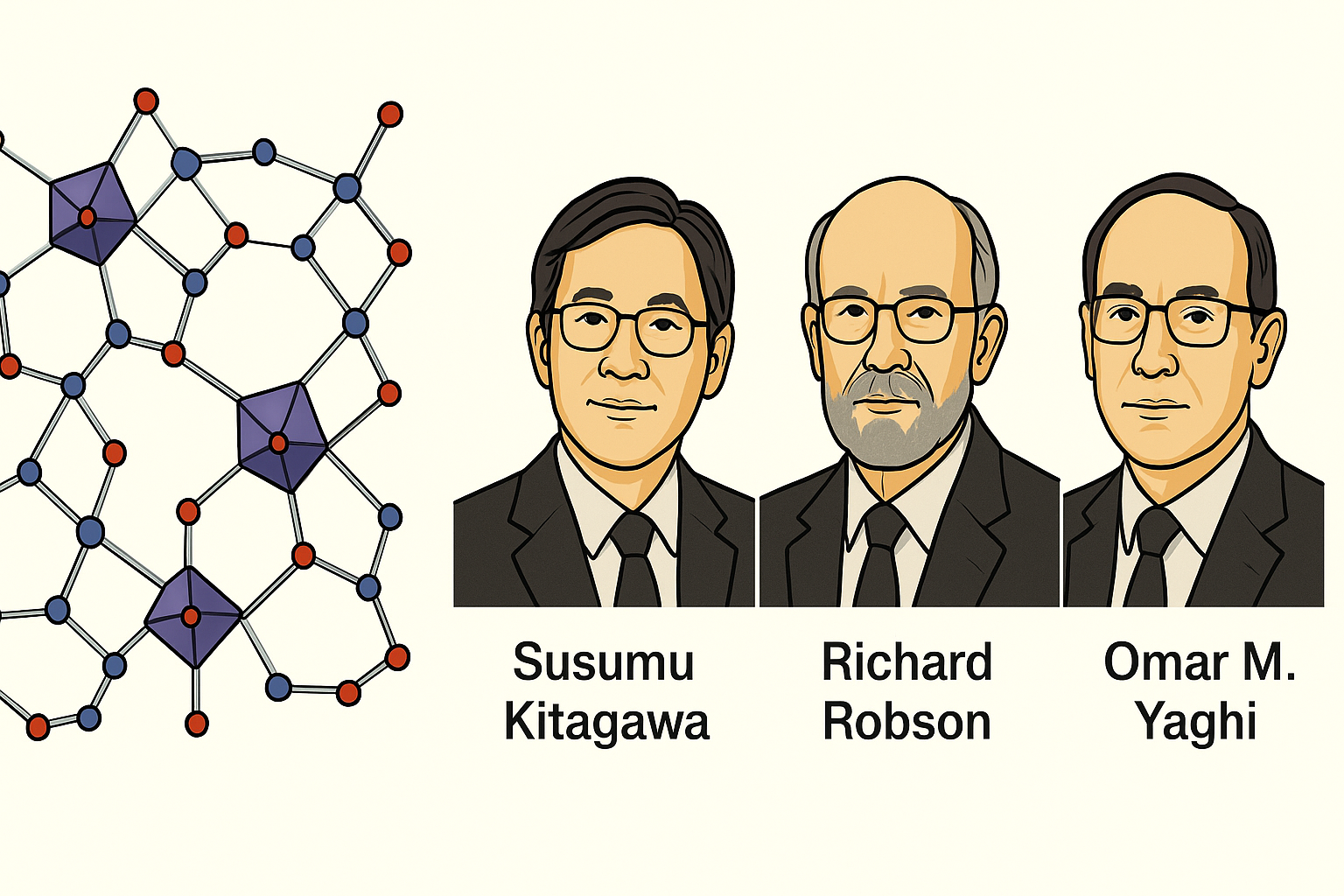
The Nobel Prize recognizes the distinct and complementary roles of the three pioneers:
Richard Robson — The Topological Architect
Robson established the design rules for coordination networks, demonstrating that by choosing specific geometries for metal nodes and linkers, chemists could reliably predict and design the final, intricate structure. His work provided the intellectual foundation for building materials with purpose, including those with specific pore environments suitable for therapeutic agents.
Susumu Kitagawa — The Functional Chemist
Kitagawa proved that MOFs are not merely static frameworks but dynamic, functional materials. His work with “soft porous crystals” showed that MOFs could “breathe,” expanding or contracting in response to guest molecules. This dynamic behavior is critical for applications like selective adsorption and controlled release mechanisms, which are essential for drug delivery.
Omar M. Yaghi — The Visionary of Reticular Chemistry
Yaghi provided the overarching design principle and executed it with spectacular success. Reticular chemistry is his legacy: a methodology for the deliberate and precise stitching of molecular units into extended frameworks. His group pioneered crucial MOF applications across various fields, including those with potential for biomedical use, by enabling the construction of frameworks with atomic precision.
Groundbreaking Applications: MOFs in the Real World
The unique, ordered porosity of MOFs translates into practical solutions for a sustainable future and, increasingly, into revolutionary advancements in healthcare:
Advanced Drug Delivery and Biomedical Use: Revolutionizing Medicine
This is where MOFs offer unparalleled promise. Biocompatible MOFs (bio-MOFs) are engineered to safely interact with biological systems, acting as sophisticated carriers for therapeutics. Other Major Applications
While biomedicine is a burgeoning field for MOFs, their impact extends across various sectors:
- Carbon Dioxide Capture and Climate Technology: MOFs are highly effective in trapping carbon dioxide (CO2) from industrial flues, even at low concentrations. Functionalized MOFs are being developed to reduce industrial emissions, offering a potentially less energy-intensive alternative to current CO2 separation technologies [Sumida, K. et al. Chem. Rev., 2012, 112, 724–781].
- Water Harvesting from Desert Air: One of the most life-changing applications is atmospheric water harvesting. Yaghi’s team developed a MOF-801-based device that uses solar energy to efficiently extract potable water from the air, even in extremely arid climates, offering a decentralized solution to global water scarcity [Fathieh, F. et al. Science Advances, 2018, 4, eaau0800].
- Clean Energy Storage: MOFs can safely store large volumes of gases like hydrogen (H2) and methane (CH4) at lower pressures than traditional tanks. This efficiency is vital for realizing a safe and viable hydrogen economy—a cornerstone of future clean energy transportation [Li, J.-R. et al. Chem. Soc. Rev., 2017, 46, 237–274].
- Catalysis and Chemical Reactions: The internal surfaces of MOFs can act as highly efficient nano-reactors, facilitating selective chemical transformations with enhanced yields, crucial for cleaner industrial processes [Gascon, J. et al. Chem. Mater., 2020, 32, 10483–10500].
Current Challenges in Biomedical MOFs
Despite their enormous potential, challenges remain for the widespread clinical translation of MOFs:
- Biocompatibility and Biodegradation: Ensuring MOFs are entirely non-toxic and safely degrade in vivo without harmful byproducts is paramount. Research focuses on using naturally occurring, biologically friendly elements (e.g., Fe, Mg, organic acids) in bio-MOF design.
- Stability in Physiological Fluids: MOFs must maintain their structural integrity and drug-loading capacity in complex biological environments (blood plasma, cellular media) for extended periods.
- Scalability for Clinical Production: Moving from laboratory synthesis to large-scale, cost-effective, and reproducible manufacturing of pharmaceutical-grade MOFs is a significant hurdle.
- Regulatory Approval: Navigating the stringent regulatory pathways for novel nanomaterials in medicine requires extensive preclinical and clinical trials.
The Future of Porous Materials in Medicine and Beyond
While challenges exist, the field is evolving rapidly. Machine Learning is now used to predict the performance of new MOFs before they are synthesized, dramatically accelerating the discovery process for both industrial and biomedical applications [Gropp, C. et al. ACS Central Science, 2020, 6, 1256–1264]. The focus is shifting to integrating these materials into targeted delivery systems, smart implantable devices, and advanced diagnostics.
The 2025 Nobel Prize is a powerful testament to the triumph of design over discovery in chemistry. Through the vision of Robson, Kitagawa, and Yaghi, Metal-Organic Frameworks are poised to become indispensable tools for Sustainable Development Goals (UN SDGs). They promise not only cleaner air, reliable water, and safer energy but also revolutionary advancements in precision medicine and personalized healthcare for generations to come.
References
- Nobel Prize in Chemistry 2025 – Press Release. https://www.nobelprize.org/prizes/chemistry/2025
- Kitagawa, S. et al. “Functional porous coordination polymers.” Angew. Chem. Int. Ed., 2004, 43, 2334–2375.
- Robson, R. “Design and construction of coordination polymers.” Coord. Chem. Rev., 1999, 185–186, 451–465.
- Yaghi, O. M. et al. “Reticular Chemistry—Construction, Properties, and Precision Reactions of Frameworks.” J. Am. Chem. Soc., 2016, 138, 15507–15516.
- Horcajada, P. et al. “Metal–organic frameworks for drug delivery: a review.” Chem. Rev., 2012, 112, 1232–1268.
- Horcajada, P. et al. “Porous metal-organic frameworks for a controlled drug delivery system.” Nature Materials, 2010, 9, 894-900.
- Lu, G. et al. “Metal-organic frameworks for imaging and diagnostics.” Coord. Chem. Rev., 2018, 361, 28-41.
- Ma, L. et al. “Metal-organic frameworks for gas storage and delivery.” Chem. Soc. Rev., 2017, 46, 361-382.
- Sumida, K. et al. “Carbon dioxide capture in metal-organic frameworks.” Chem. Rev., 2012, 112, 724–781.
- Fathieh, F. et al. “Water harvesting from air with metal–organic frameworks powered by natural sunlight.” Science Advances, 2018, 4, eaau0800.
- Li, J.-R. et al. “Metal–organic frameworks for hydrogen storage.” Chem. Soc. Rev., 2017, 46, 237–274.
- Gascon, J. et al. “Metal-organic frameworks as heterogeneous catalysts: opportunities and challenges.” Chem. Mater., 2020, 32, 10483–10500.
- Gropp, C. et al. “Navigating the Metal-Organic Framework Landscape with Machine Learning.” ACS Cent. Sci., 2020, 6, 1256–1264.
- CAS Insights – Nobel Chemistry 2025: Metal–Organic Frameworks. https://www.cas.org/resources/cas-insights/nobel-mofs
Hi…! Currently, I am working as an Professor at Department of Pharmaceutical Chemistry(H.O.D),The Pharmaceutical College, Barpali, Odisha. I have more than 19 years of teaching & research experience in the field of Chemistry & Pharmaceutical sciences.