
Introduction
Radiopharmaceuticals are radioactive medicinal preparations used in diagnosis, treatment, and research. They are an important topic in pharmaceutical inorganic chemistry because they combine nuclear chemistry, inorganic salts, complex formation, radiation safety, quality control, and clinical pharmacy.
According to the textbook approach followed in Pharmaceutical Inorganic Chemistry by Gurdeep Raj Chatwal, the study of radioactive substances is not limited to their nuclear properties. Pharmacy students must also understand their preparation, storage, handling precautions, pharmaceutical applications, and safe use in hospitals and laboratories.
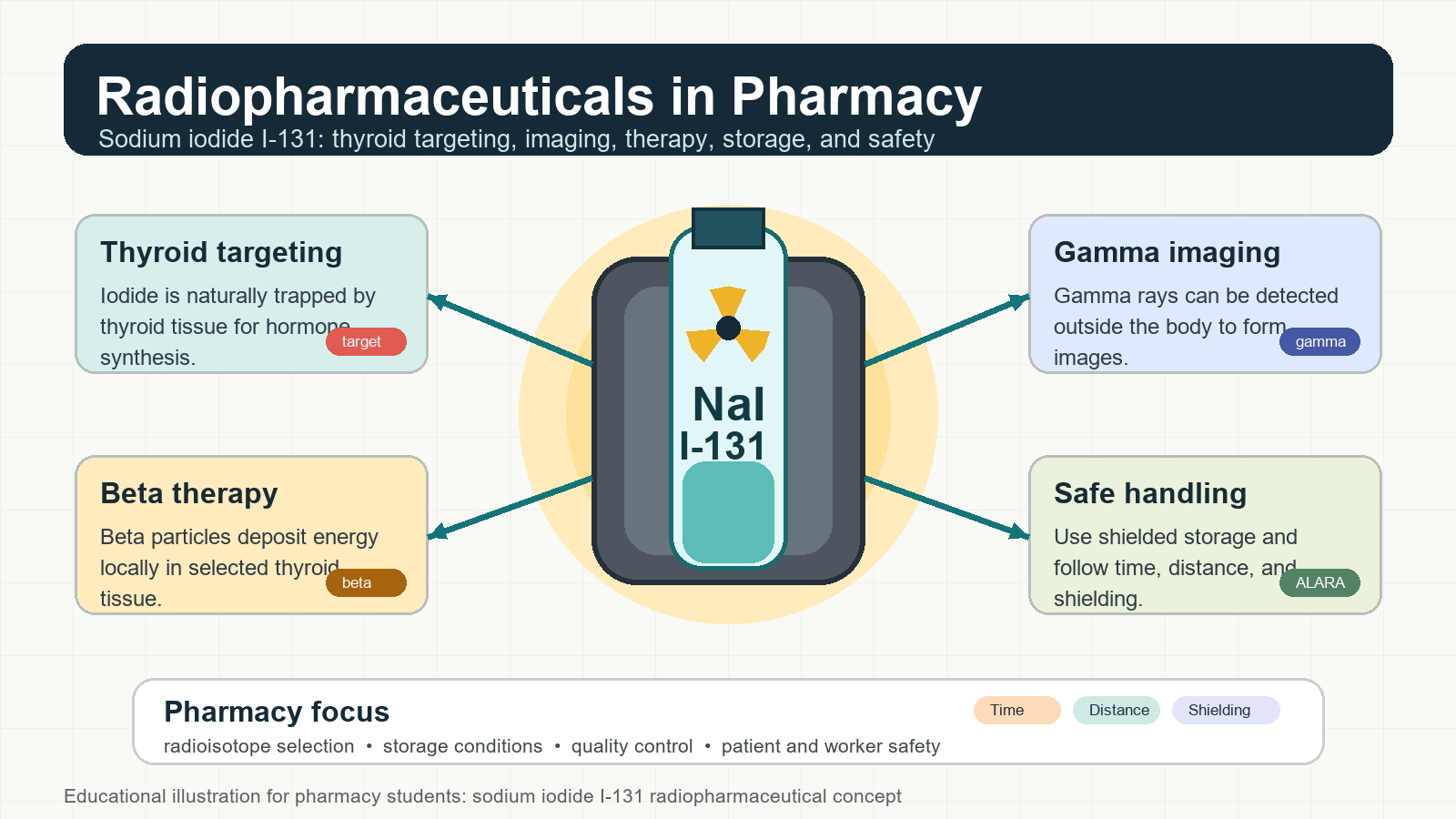
Think of sodium iodide I-131 as a tiny radioactive messenger: it follows the same iodine pathway used by the thyroid gland, but its radiation makes it useful for imaging, therapy, and pharmaceutical study.
Learning objectives
- Understand the meaning of radiopharmaceuticals and radioisotopes.
- Study important applications of radiopharmaceuticals in pharmacy and medicine.
- Understand sodium iodide I-131 as an important radioisotope preparation.
- Learn storage conditions and precautions for radioactive substances.
- Revise pharmaceutical applications of radioactive substances in an exam-friendly way.
What are radiopharmaceuticals?
A radiopharmaceutical is a medicinal product that contains one or more radioactive isotopes and is used for diagnosis, therapy, or biological investigation.
In simple words, a radiopharmaceutical is a radioactive drug. It is designed to localize in a specific organ, tissue, or physiological pathway. The radiation emitted from the radioisotope is then used either to produce an image or to destroy diseased tissue.
What are radioisotopes?
Radioisotopes are unstable isotopes of elements that undergo radioactive decay and emit radiations such as alpha particles, beta particles, gamma rays, or positrons. These emissions make radioisotopes useful in pharmaceutical science, nuclear medicine, sterilization, analytical studies, and biological tracing.
Examples of medically useful radioisotopes include technetium-99m, iodine-131, fluorine-18, phosphorus-32, yttrium-90, lutetium-177, and radium-223.
Important properties of radioisotopes
- Half-life: Time required for radioactivity to reduce to half of its initial value.
- Type of radiation: Gamma rays and positrons are useful for imaging, while beta and alpha particles are useful for therapy.
- Energy of emission: Radiation energy affects image quality, tissue penetration, and safety.
- Biological localization: The compound should reach the desired organ or tissue.
- Radiochemical purity: The radioactive isotope should be present in the correct chemical form.
Ideal characteristics of radiopharmaceuticals
An ideal radiopharmaceutical should have the following properties:
- It should selectively concentrate in the target organ or tissue.
- It should have suitable physical half-life for the intended use.
- It should emit radiation suitable for diagnosis or therapy.
- It should be chemically stable during preparation, storage, and use.
- It should have high radiochemical purity.
- It should be sterile and pyrogen-free when used by injection.
- It should be non-toxic at the administered quantity.
- It should be eliminated from non-target tissues as quickly as possible.
- It should be easy to prepare, assay, dispense, and store safely.
Classification of radiopharmaceuticals
1. Diagnostic radiopharmaceuticals
Diagnostic radiopharmaceuticals are used to study organ structure and function. They emit gamma rays or positrons that can be detected outside the body using imaging instruments such as gamma cameras, SPECT scanners, or PET scanners.
Examples include technetium-99m labelled compounds, fluorine-18 fluorodeoxyglucose, gallium-68 labelled peptides, and iodine radioisotopes used for thyroid studies.
2. Therapeutic radiopharmaceuticals
Therapeutic radiopharmaceuticals deliver radiation to diseased tissue. They generally emit beta particles or alpha particles, which deposit energy over a short distance and damage abnormal cells.
Examples include sodium iodide I-131 for thyroid disorders, lutetium-177 labelled agents for targeted radionuclide therapy, yttrium-90 preparations, and radium-223 dichloride for selected bone-related cancer conditions.
3. Research and tracer radiopharmaceuticals
Radioactive substances are also used as tracers in pharmaceutical research. A small amount of radioactive material can help trace absorption, distribution, metabolism, excretion, receptor binding, and biochemical pathways.
Study of Sodium Iodide I-131
Sodium iodide I-131 is one of the most important radiopharmaceutical examples for pharmacy students. It contains radioactive iodine-131 in the form of sodium iodide.
Iodine is naturally taken up by the thyroid gland for the synthesis of thyroid hormones. Sodium iodide I-131 uses this physiological property. After administration, iodide ions are concentrated by thyroid tissue. The emitted radiation is then useful for thyroid imaging or thyroid therapy, depending on the purpose and administered activity.
Nuclear properties of I-131
| Property | Sodium iodide I-131 |
|---|---|
| Radioisotope | Iodine-131 |
| Approximate physical half-life | About 8 days |
| Main emissions | Beta particles and gamma rays |
| Chemical form | Sodium iodide containing radioactive iodine |
| Main target organ | Thyroid gland |
Dosage forms of sodium iodide I-131
Sodium iodide I-131 may be supplied as oral capsules or oral solution. It must be handled, stored, dispensed, and administered only under authorized nuclear medicine and radiation safety conditions.
For students, it is important to remember that the medicinal value of sodium iodide I-131 depends on both its chemical behavior as iodide and its radioactive emissions as iodine-131.
Pharmaceutical applications of sodium iodide I-131
- Thyroid uptake studies: It can help evaluate iodine uptake by thyroid tissue.
- Thyroid imaging: Its gamma emission can be detected for imaging, although lower-dose alternatives may be preferred in many diagnostic settings.
- Hyperthyroidism treatment: Its beta particles can reduce overactive thyroid tissue under medical supervision.
- Thyroid cancer management: It may be used for ablation of residual thyroid tissue or treatment of iodine-avid thyroid cancer under specialist care.
Why I-131 is useful in thyroid disorders
The thyroid gland naturally traps iodide. Therefore, radioactive iodide is selectively concentrated in thyroid tissue. The beta radiation of I-131 produces a local destructive effect, while the gamma radiation can be detected externally. This dual property makes sodium iodide I-131 both diagnostically and therapeutically important.
Storage conditions of radiopharmaceuticals
Radiopharmaceuticals require special storage because they are both medicinal products and radioactive materials.
- They should be stored in a designated, authorized radiation area.
- They should be kept in suitable shielded containers, such as lead-shielded pots, vial shields, or capsule containers.
- The storage area should be locked and access should be restricted to trained personnel.
- Labels should clearly show the name of the radioisotope, activity, calibration date and time, expiry time, batch details, and radiation warning symbol.
- They should be stored separately from ordinary pharmaceutical preparations.
- Storage conditions such as temperature and container type should follow the manufacturer label and official radiopharmacy procedure.
- Volatile or easily contaminating radioactive materials should be handled with extra care and appropriate ventilation.
- Expired or unused radioactive material should be managed as radioactive waste according to radiation safety rules.
Special storage points for sodium iodide I-131
- It should be stored in a well-shielded container because I-131 emits penetrating gamma radiation.
- It should be stored in a secure radioactive material storage area.
- The container should remain closed except when dispensing or measuring activity.
- It should be clearly labelled as sodium iodide I-131 with activity and calibration details.
- Because activity decreases with time, decay correction is necessary before administration.
- Contamination checks should be performed after handling, especially around dispensing areas.
Precautions while handling radioactive substances
The basic principle of radiation safety is ALARA, meaning radiation exposure should be kept As Low As Reasonably Achievable.
1. Time
Spend minimum time near radioactive materials. All steps should be planned before opening the shielded container.
2. Distance
Keep maximum possible distance from the radioactive source. Forceps, tongs, and remote handling tools help increase distance.
3. Shielding
Use appropriate shielding according to the radiation type. Lead shielding is commonly used for gamma emitters such as I-131, while beta emitters may require suitable plastic or acrylic shielding to reduce bremsstrahlung radiation.
General laboratory precautions
- Handle radioactive substances only in authorized laboratories or radiopharmacy areas.
- Wear laboratory coat, disposable gloves, and personal dosimeter where required.
- Never eat, drink, smoke, or apply cosmetics in the radioactive work area.
- Do not pipette radioactive solutions by mouth.
- Use absorbent bench paper and contamination trays during dispensing.
- Use syringe shields, vial shields, lead glass screens, and suitable transport containers.
- Monitor hands, clothing, benches, and instruments after handling.
- Record receipt, use, storage, disposal, and remaining activity.
- Report spills immediately and follow the radiation safety officer’s instructions.
- Pregnant workers should follow institutional radiation safety policies and exposure limits.
Quality control of radiopharmaceuticals
Quality control is essential because radiopharmaceuticals are administered to patients and contain radioactive material. Important quality tests include:
- Radionuclidic purity: Confirms that the correct radioisotope is present.
- Radiochemical purity: Confirms that the radioactivity is present in the desired chemical form.
- Chemical purity: Checks for non-radioactive chemical impurities.
- Sterility: Required for injectable preparations.
- Pyrogen testing: Required for parenteral radiopharmaceuticals.
- pH and isotonicity: Important for patient safety and compatibility.
- Particle size: Important for some preparations such as lung perfusion agents.
Applications and uses of radiopharmaceuticals
1. Diagnostic imaging
Radiopharmaceuticals are widely used to diagnose diseases by studying organ function. Unlike ordinary X-rays, nuclear medicine imaging often shows physiological activity rather than only anatomy.
- Thyroid scan using iodine radioisotopes or technetium compounds.
- Bone scan using technetium-99m labelled phosphonates.
- Renal scan to assess kidney function and drainage.
- Hepatobiliary scan to study bile flow.
- Cardiac perfusion imaging to study blood supply to heart muscle.
- PET imaging using fluorine-18 FDG to study glucose metabolism.
2. Therapeutic use
Therapeutic radiopharmaceuticals deliver radiation directly to selected tissues. This is useful when the radioactive compound can concentrate in diseased tissue more than normal tissue.
- Sodium iodide I-131 for selected thyroid disorders.
- Yttrium-90 preparations for selected liver and joint applications.
- Lutetium-177 labelled agents for targeted radionuclide therapy.
- Radium-223 dichloride for selected cancer-related bone conditions.
- Phosphorus-32 in selected historical or specialist therapeutic uses.
3. Tracer studies in pharmaceutical research
Radioisotopes are used as tracers to study the movement of substances in the body. This is useful in pharmacokinetic and metabolic studies because even very small amounts of radioactivity can be detected accurately.
- Absorption studies.
- Distribution studies.
- Metabolism studies.
- Excretion studies.
- Protein binding and receptor binding studies.
4. Radioimmunoassay and analytical applications
Radioactive substances have been used in sensitive analytical methods such as radioimmunoassay. These methods can detect very small amounts of hormones, drugs, enzymes, vitamins, and antigens.
5. Sterilization of pharmaceutical products
Gamma radiation from suitable radioactive sources, such as cobalt-60, is used industrially for sterilization of certain medical and pharmaceutical products. This is especially useful for heat-sensitive disposable items. This application uses radioactive substances as radiation sources, not as medicines administered to patients.
6. Biological and biochemical research
Radioactive tracers are useful in studying enzyme reactions, DNA synthesis, protein turnover, drug localization, and biochemical pathways. They help scientists understand biological processes at very low concentrations.
Common radiopharmaceutical examples
| Radioisotope or preparation | Main radiation | Approximate half-life | Main use |
|---|---|---|---|
| Technetium-99m compounds | Gamma | About 6 hours | SPECT imaging of bone, heart, kidney, liver, and other organs |
| Sodium iodide I-131 | Beta and gamma | About 8 days | Thyroid diagnosis and therapy |
| Fluorine-18 FDG | Positron | About 110 minutes | PET imaging, especially metabolic imaging |
| Gallium-68 labelled agents | Positron | About 68 minutes | PET imaging of selected receptors |
| Yttrium-90 preparations | Beta | About 64 hours | Targeted therapy and radioembolization applications |
| Lutetium-177 labelled agents | Beta and gamma | About 6.7 days | Targeted radionuclide therapy |
| Radium-223 dichloride | Alpha | About 11.4 days | Selected bone-targeted therapy |
Advantages of radiopharmaceuticals
- They help detect disease at a functional level.
- They can localize in specific organs or tissues.
- Small quantities are usually sufficient for diagnosis.
- Some agents can combine diagnosis and therapy.
- They are useful in research, quality control, and pharmaceutical analysis.
Limitations of radiopharmaceuticals
- They require strict radiation safety precautions.
- They have limited shelf life due to radioactive decay.
- Special storage, transport, and disposal systems are needed.
- Preparation and administration require trained personnel.
- Pregnancy, lactation, and renal function may require special clinical consideration.
- They may be expensive and require specialized nuclear medicine facilities.
summary
| Radiopharmaceutical | Radioactive medicinal preparation used for diagnosis, therapy, or research. |
|---|---|
| Radioisotope | Unstable isotope that emits radiation during decay. |
| Important diagnostic isotope | Technetium-99m. |
| Important thyroid isotope | Iodine-131 as sodium iodide I-131. |
| Sodium iodide I-131 radiation | Beta and gamma emissions. |
| Main target organ of I-131 | Thyroid gland. |
| Basic safety rule | Minimum time, maximum distance, suitable shielding. |
| Storage requirement | Shielded, labelled, locked radioactive storage area. |
| Major QC tests | Radionuclidic purity, radiochemical purity, chemical purity, sterility, pyrogen test, pH. |
References and further reading
- Gurdeep Raj Chatwal, Textbook of Pharmaceutical Inorganic Chemistry, sections on radioactivity, radioisotopes, and radiopharmaceuticals.
- Gopal B. Saha, Fundamentals of Nuclear Pharmacy, standard reference for radiopharmaceutical principles and nuclear pharmacy.
- U.S. Nuclear Regulatory Commission, radiation protection principles: https://www.nrc.gov/about-nrc/radiation/protects-you/protection-principles.html
- DailyMed, U.S. National Library of Medicine, drug labels for radiopharmaceutical products: https://dailymed.nlm.nih.gov/dailymed/
- International Atomic Energy Agency, radiopharmaceutical and nuclear medicine resources: https://www.iaea.org/topics/radiopharmaceuticals
Conclusion
Radiopharmaceuticals are important radioactive medicinal preparations used in diagnosis, therapy, and pharmaceutical research. For pharmacy students, their study includes radioisotope properties, clinical applications, storage conditions, safety precautions, and quality control. Sodium iodide I-131 is a key example because it shows how a simple inorganic salt can become a powerful diagnostic and therapeutic agent when labelled with a suitable radioisotope.
Hi…! Currently, I am working as an Professor at Department of Pharmaceutical Chemistry(H.O.D),The Pharmaceutical College, Barpali, Odisha. I have more than 19 years of teaching & research experience in the field of Chemistry & Pharmaceutical sciences.