
Learning objectives
- Define bioisosterism and bioisostere in medicinal chemistry.
- Differentiate classical and non-classical bioisosteres.
- Explain why bioisosteric replacement is used during lead optimization.
- Connect student-level examples with researcher-level drug design decisions.
What is bioisosterism?
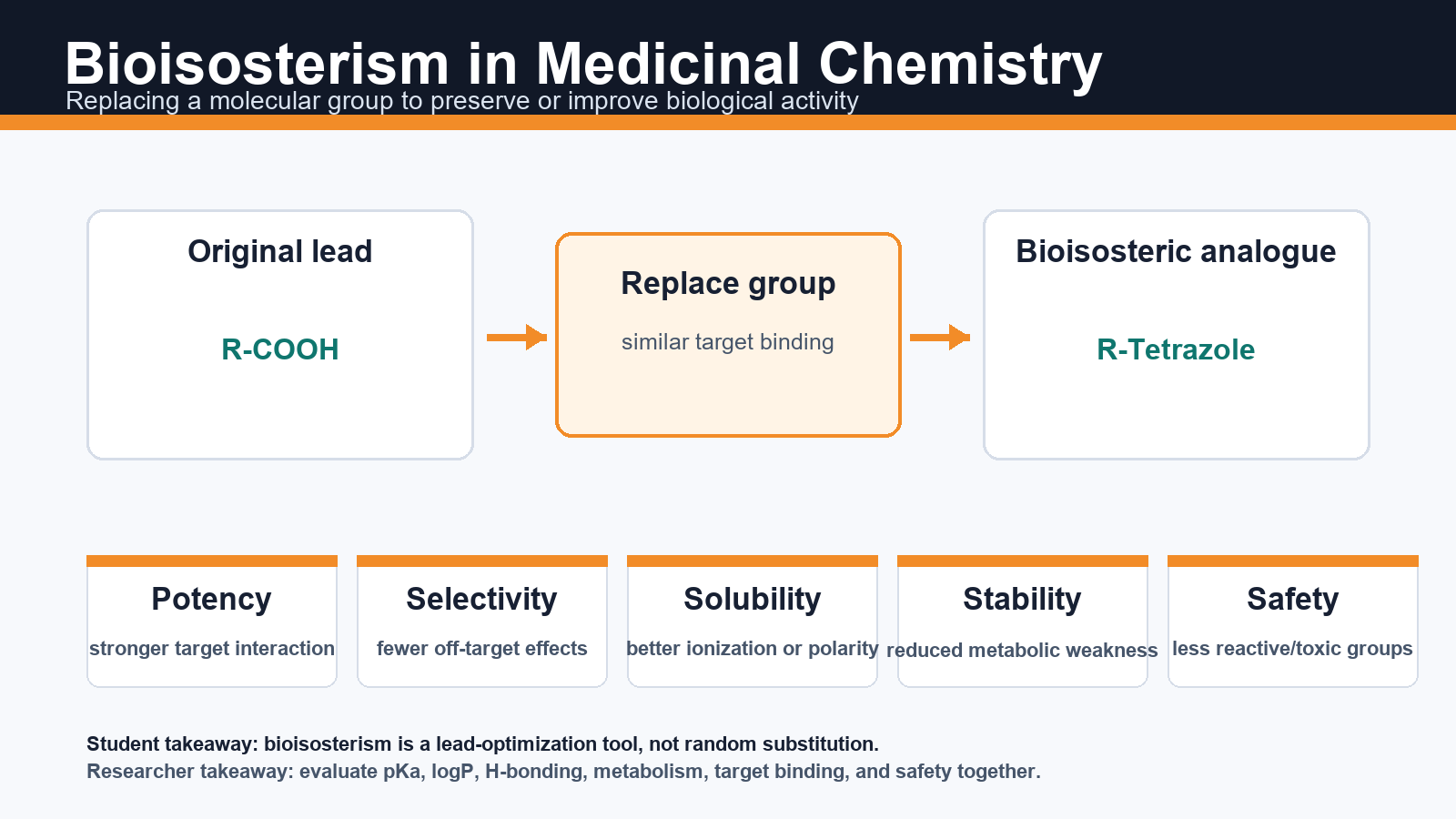
Bioisosterism is a medicinal chemistry strategy in which one atom, functional group, or molecular fragment in a biologically active compound is replaced by another group that gives a similar or improved biological effect. The replacement group is called a bioisostere.
The goal is not random substitution. A useful bioisosteric replacement should preserve the key interaction with the biological target while improving one or more drug-like properties such as potency, selectivity, solubility, metabolic stability, safety, or oral absorption.
Simple definition for students
Bioisosterism means replacing one part of a drug molecule with another part that behaves similarly in the body, but may make the drug better.
Researcher-friendly definition
In lead optimization, bioisosterism is the rational replacement of a structural element with another fragment that maintains the required steric, electronic, hydrogen-bonding, and pharmacophoric features while tuning physicochemical, pharmacokinetic, or toxicological properties.
Why bioisosterism is important in drug design
A small structural change can strongly affect how a molecule binds, dissolves, crosses membranes, resists metabolism, and produces side effects. Bioisosteric replacement is therefore a practical tool for solving common problems in drug discovery.
- Potency: improves target binding by optimizing shape, charge, or hydrogen bonding.
- Selectivity: reduces binding to unwanted receptors or enzymes.
- Solubility: changes polarity, ionization, and hydrogen-bonding capacity.
- Metabolic stability: replaces metabolically weak groups with more stable alternatives.
- Safety: removes reactive or toxic functional groups while retaining activity.
- Pharmacokinetics: adjusts logP, pKa, permeability, and clearance.
Classical and non-classical bioisosteres
1. Classical bioisosteres
Classical bioisosteres are based on similarity in valency, size, electronic structure, or periodic table relationships. These replacements often follow simple chemical similarity rules.
| Classical replacement | Examples | Possible effect |
|---|---|---|
| Monovalent atoms/groups | H, F, Cl, OH, NH2, CH3 | Changes size, polarity, metabolism, or binding |
| Divalent atoms/groups | O, S, NH, CH2 | Changes hydrogen bonding and lipophilicity |
| Trivalent atoms/groups | N, CH | Changes ring electronics and basicity |
| Tetravalent atoms | C, Si | Changes steric volume and lipophilicity |
| Aromatic ring equivalents | Benzene, pyridine, thiophene | Changes polarity, metabolism, and target interaction |
2. Non-classical bioisosteres
Non-classical bioisosteres do not necessarily have the same number of atoms or identical valency, but they can mimic the important biological effect of the original group. These replacements are especially important in modern drug design.
Examples include replacing a carboxylic acid with a tetrazole, an amide with a heterocycle, or a phenyl ring with a heteroaromatic ring.
Important examples of bioisosteric replacement
Carboxylic acid to tetrazole
A carboxylic acid group may be replaced by a tetrazole ring. Both can act as acidic groups, but tetrazole may change lipophilicity, metabolic stability, and receptor binding. This is one of the most common examples discussed in medicinal chemistry.
Hydrogen to fluorine
Fluorine can replace hydrogen at a metabolically sensitive position. Because fluorine is small and highly electronegative, it can block oxidative metabolism, modify pKa, and influence target binding without dramatically changing molecular size.
Benzene to pyridine
A phenyl ring can be replaced by a pyridine ring to introduce a nitrogen atom. This can increase polarity, provide a hydrogen-bond acceptor, change pKa, and improve solubility or binding selectivity.
Oxygen to sulfur
Oxygen and sulfur replacements can change size, polarizability, lipophilicity, and metabolic behavior. Sulfur is larger and more polarizable than oxygen, so the biological result must be tested experimentally.
How researchers evaluate a bioisosteric replacement
A researcher should not judge a bioisostere by chemical similarity alone. The replacement must be evaluated using biological, physicochemical, and ADMET data.
| Question | Why it matters |
|---|---|
| Does target potency improve or remain acceptable? | Confirms that the pharmacophore is preserved. |
| Does selectivity improve? | Reduces off-target activity and side effects. |
| What happens to pKa and logP? | Controls ionization, permeability, and solubility. |
| Is metabolic stability improved? | May increase half-life and reduce rapid clearance. |
| Are new safety alerts introduced? | Prevents reactive, toxic, or unstable groups. |
| Is the analogue synthetically accessible? | Drug design must remain practical for synthesis. |
Applications of bioisosterism
1. Lead optimization
Bioisosterism is widely used after a lead compound is identified. The medicinal chemist modifies selected groups to improve the balance between activity, selectivity, and drug-like properties.
2. Improving metabolic stability
If a compound is rapidly metabolized at a vulnerable position, a bioisostere can reduce metabolism. Fluorine substitution is a common example when used carefully.
3. Reducing toxicity
A reactive or toxic functional group can sometimes be replaced with a safer bioisostere while preserving the desired pharmacological activity.
4. Improving oral absorption
Bioisosteric replacement can tune polarity, ionization, and lipophilicity, which affects membrane permeability and oral bioavailability.
Advantages of bioisosterism
- Maintains or improves biological activity.
- Improves potency and selectivity.
- Optimizes solubility, pKa, and lipophilicity.
- Reduces metabolic degradation.
- May reduce toxicity and off-target effects.
- Supports rational drug design and SAR studies.
Limitations
Bioisosterism is useful, but it is not guaranteed to improve a molecule. A replacement may reduce target binding, disturb molecular conformation, introduce toxicity, or make synthesis difficult. Therefore, every bioisosteric analogue must be tested experimentally.
Exam-focused summary
| Term | Bioisosterism |
|---|---|
| Meaning | Replacement of one atom, group, or fragment with another that gives similar or improved biological effect. |
| Replacement group | Bioisostere |
| Main use | Lead optimization in medicinal chemistry |
| Major benefit | Improves potency, selectivity, solubility, stability, safety, or pharmacokinetics |
| Types | Classical and non-classical bioisosteres |
References and further reading
- Patani, G. A.; LaVoie, E. J. Bioisosterism: A Rational Approach in Drug Design. Chemical Reviews, 1996. DOI: 10.1021/cr950066q.
- Meanwell, N. A. Synopsis of Some Recent Tactical Application of Bioisosteres in Drug Design. Journal of Medicinal Chemistry, 2011. DOI: 10.1021/jm1013693.
- Lima, L. M.; Barreiro, E. J. Bioisosterism: A Useful Strategy for Molecular Modification and Drug Design. Current Medicinal Chemistry, 2005. DOI: 10.2174/0929867053363540.
- Brown, N., editor. Bioisosteres in Medicinal Chemistry. Wiley-VCH, 2012.
Conclusion
Bioisosterism is a central tool in medicinal chemistry because it connects chemical structure with biological performance. For students, it explains why small structural changes can produce large pharmacological differences. For researchers, it provides a rational method for optimizing potency, selectivity, ADMET properties, and safety during drug discovery.
Hi…! Currently, I am working as an Professor at Department of Pharmaceutical Chemistry(H.O.D),The Pharmaceutical College, Barpali, Odisha. I have more than 19 years of teaching & research experience in the field of Chemistry & Pharmaceutical sciences.